
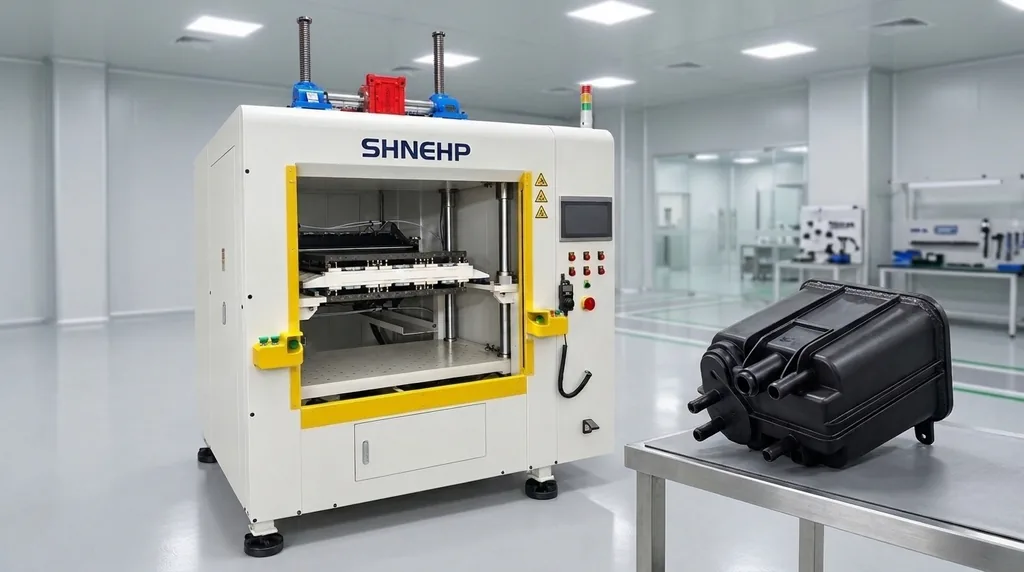
Automotive evaporative emission control (EVAP) charcoal canisters capture volatile fuel vapors from the gas tank and purge them cleanly into the engine intake to meet stringent China 6, Euro 7, and LEV III / Tier 3 zero-evaporation regulations. Inside every canister sit spring-loaded activated-carbon beds, foam filters, and multi-chamber purge baffles that must be hermetically locked under continuous spring pre-load. Applying hot plate welding evaporator canister housings permanently fuses PA6, PA66, PA66-GF, or barrier HDPE canister bodies to multi-port end caps and internal divider walls with ultra-low hydrocarbon permeation and zero chemical leak paths. SHNEHP engineers 3-axis servo and non-contact IR hot plate platforms (XNS5-B, XNS6-B, XNS8-B) for Tier-1 automotive emission-system manufacturers.
The part and its welding challenges
EVAP carbon canisters operate under vehicle underbodies exposed to road-salt spray, stone impact, fuel vapors, and pressurized onboard diagnostic (OBD-II) leak checks. Five manufacturing realities govern canister welding yield:
- Welding against active internal spring compression and carbon-pellet dust: Before the end cap is sealed, coil springs press filter pads tightly against packed activated-carbon granules; tooling must compress the spring pack cleanly during joining while keeping stray carbon dust 100% off the molten weld face (a single carbon pellet trapped in the seam creates an instant EVAP failure).
- Simultaneous outer-perimeter and internal multi-chamber partition sealing: Dual- and triple-bed EVAP canisters require internal labyrinth divider walls to fuse simultaneously with the outer perimeter wall so raw fuel vapors cannot short-circuit directly from tank port to atmosphere vent.
- High-temperature polyamide (PA6 / PA66 / PA66-GF) PTFE wear & moisture control: Nylon 66 and glass-filled PA66 demand platen temperatures above the ~270 °C durability limit of standard PTFE coatings and readily absorb ambient moisture; improper drying or degraded PTFE causes foaming voids and cold stringing.
- Zero-permeation EVAP tightness under strict emission standards: Canisters must pass 10–35 kPa pressure-decay tests (and helium tracer verification where OEM specs drop below 0.05 mL/min) across -40 °C to +90 °C thermal shock cycles.
- Port concentricity and mounting-bracket datum accuracy: Quick-connect SAE purge, load, and vent nipples molded onto the end cap cannot warp during clamping, ensuring reliable automated harness and fuel-line clicks at vehicle assembly.
Why hot plate welding (vs. alternatives)
| Process | Fit for EVAP charcoal canisters | Internal partition sealing & cleanliness | Typical cycle time | Engineering boundary |
|---|---|---|---|---|
| 3-axis servo / non-contact IR hot plate welding (XNS5-B / XNS6-B / XNS8-B) | Industry-standard choice for PA6, PA66, PA66-GF, and HDPE multi-chamber EVAP canisters with spring-loaded beds | Simultaneously seals deep outer flanges + internal divider walls; zero mechanical vibration shaking carbon pellets onto the weld lip | ~22–38 s (single or 2-up) | Use non-contact IR (300–500 °C) for PA66 / PA66-GF above ~270 °C PTFE ceiling; keep spring-compression shields clean of carbon dust |
| Linear vibration friction welding (XN-55 / XN-70) | Rigid flat-lid canisters where carbon beds are pre-sealed inside separate cartridges | Fast 2–5 s weld cycle | ~10–18 s total | High-G lateral vibration can shake loose activated-carbon fines directly onto the weld interface, causing micro-leaks unless beds are fully isolated |
| Spin welding (XNX-100 / XNX-200) | Cylindrical single-chamber canister end plugs | Fast 0.5–3 s circular seal | ~0.5–3 s | Cannot seal rectangular multi-bed canisters or internal divider baffles |
| Ultrasonic welding | Tiny purge-valve caps or secondary vent ports only | Sub-second auxiliary port attachment | ~0.3–1.0 s | Insufficient melt volume and seam consistency for full EVAP canister end caps |
Typical process window (industry ranges)
EVAP canister welding adheres to DVS 2215 displacement-controlled thermal fusion, with mandatory moisture control on polyamides and spring-compression compensation in the servo joining profile. Exact windows are verified during a SHNEHP trial.
| Parameter | Typical industry range (PA6 / PA66 / PA66-GF / HDPE) | Engineering guidance |
|---|---|---|
| Pre-weld drying | PA6 / PA66 / PA66-GF: 80–100 °C (or weld dry-as-molded) | Mandatory to prevent steam micro-porosity that fails strict EVAP leak rates |
| Heating mode & temperature | HDPE contact: 220–255 °C; PA6/PA66/PA66-GF (>270 °C or GF≥40%): non-contact IR 320–480 °C | Non-contact IR avoids PTFE degradation and carbonized specks on nylon canisters |
| Bead-up / heating soak | Contact bead-up 0.5–0.8 mm; soak 8–18 s (or 1–2 mm IR radiant gap) | Dedicated dust-shroud tooling blocks carbon dust while heating outer + internal ribs evenly |
| Servo changeover time | ≤1.5–2.2 s | Rapid 3-axis servo retraction prevents rapid nylon crystallization before joining |
| Joining & hold phase | 0.20–0.35 N/mm² (overcoming internal spring pre-load) to closed-loop servo hard stop (1.5–2.5 mm); hold 8–16 s | Servo force-distance curve verifies both outer rim and internal divider compression |
Recommended SHNEHP machine and fixture setup
SHNEHP builds heavy-rigidity 3-axis servo hot plate welding machines engineered for multi-cavity emission canister cells (+60 mm platen clearance margin around fixtures):
- Single & 2-cavity EVAP canister lines: XNS5-B and XNS6-B 3-axis full-servo hot plate welders offer high clamping force to compress internal canister coil springs reliably, closed-loop micron collapse stops, and optional non-contact IR heating heads for PA66 / PA66-GF canisters.
- High-volume 2-to-4-cavity canister platforms: XNS8-B servo hot plate machines deliver balanced multi-cavity production with automated dust extraction hoods and quick-change rolling tooling plates.
- Carbon-dust-protected fixtures: Custom welding and testing fixtures integrate spring-retaining vacuum nests, positive-pressure air-knife dust shields, and direct transfer into inline EVAP leak-test benches via customized machines.
Quality and leak testing
EVAP canisters enforce some of the tightest emission leak standards in automotive manufacturing:
- 100% serialized EVAP leak testing: Every welded canister undergoes differential pressure-decay verification at 10–35 kPa against an acceptance threshold of 0.1–0.5 mL/min (1 Pa resolution, 3–5 s stabilization). Where OEM China 6 / LEV III specifications demand ultra-low leakage (<0.05 mL/min), lines integrate helium mass-spectrometry sniffer or vacuum-chamber testing.
- Internal bypass & burst validation: Inline flow-path pressure-drop checks verify that internal partition walls fused completely (zero vapor short-circuiting), paired with periodic hydrostatic burst and thermal-shock audits.
FAQ
Why is hot plate welding preferred over vibration welding for activated-carbon EVAP canisters? Hot plate welding involves zero high-G lateral shaking, so loose activated-carbon granules and fine carbon dust stay contained beneath the filter pad instead of migrating onto the weld flange and creating micro-leaks.
When should EVAP canister lines use non-contact IR instead of contact PTFE hot plates? Whenever canisters are molded in PA66 or glass-filled PA66-GF requiring platen temperatures above the ~270 °C durability limit of PTFE coatings (or GF≥40%), non-contact infrared heating (300–500 °C) eliminates coating wear, sticking, and stringing.
Can SHNEHP hot plate welders seal both the outer perimeter and internal multi-bed divider walls at once? Yes. Contoured 3-axis servo platens heat the perimeter wall and all internal labyrinth partitions simultaneously, while servo force-displacement curves verify complete fusion across every chamber.
What leak-testing specification applies to welded automotive EVAP canisters? Standard inline EVAP differential pressure-decay tests run at 10–35 kPa with a 0.1–0.5 mL/min limit; if an automaker requires ultra-tight leakage below 0.05 mL/min, SHNEHP integrates helium leak-testing stations.
What engineering information should we share for an EVAP canister weld trial? Send 3D STEP/X_T models showing outer walls, internal dividers, and spring-bed pre-load force, exact PA6/PA66/HDPE resin grade, target hourly output, and OEM EVAP leak limits.
Get a free weld trial
Share your EVAP charcoal canister CAD models with SHNEHP engineering to evaluate contact vs. non-contact IR hot plate welding, carbon-dust shielding, and 100% inline EVAP leak-test integration:
- 3D STEP / X_T / IGES models of canister body, divider walls, and end cap
- Polymer grade (PA6, PA66, PA66-GF, HDPE) and internal spring pre-load force
- EVAP leak threshold (kPa, mL/min, or helium spec) and target UPH
Email yy@nbxiaoneng.com or submit your project via our contact page.
Request a Technical Consultation & Free Weld Trial
Send your 3D STEP/X_T drawing, resin grade, target cycle time, and leak-test specification. Our engineers will evaluate the joint and recommend a practical SHNEHP machine and fixture setup.