
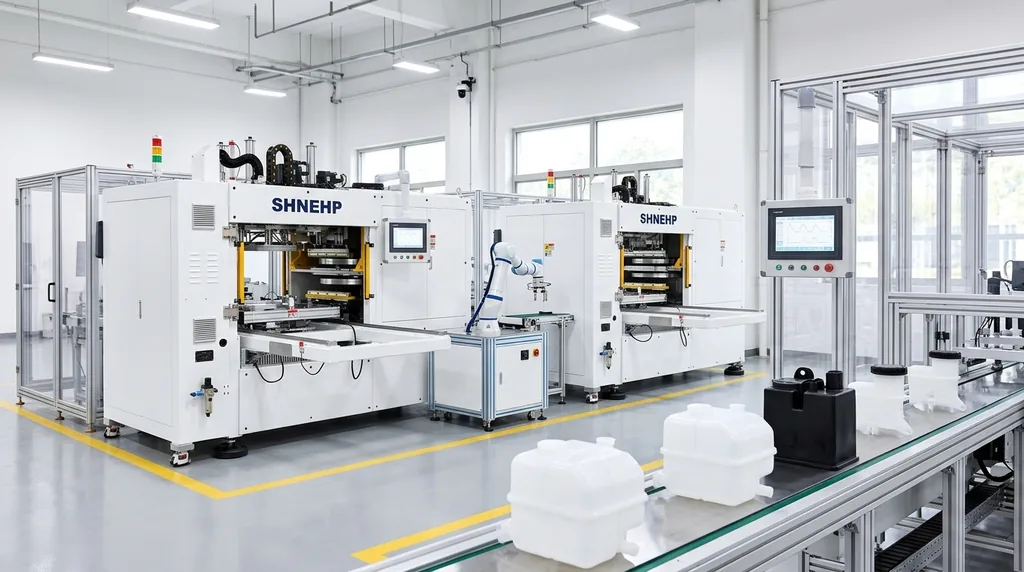
Modern EV thermal-management degas bottles, pressurized coolant reservoirs, hydraulic brake-fluid tanks, SCR urea (AdBlue) tanks, windshield washer bottles, and EVAP charcoal canisters demand zero-leak field reliability at demanding Tier-1 automotive production rates. Running isolated manual welding presses followed by hand-loaded leak-test benches introduces inconsistent cooling times, mis-installed internal baffles or level sensors, high labor costs, and disconnected quality records. Deploying custom automation automotive fluid systems unifies component verification, servo hot plate / non-contact IR / linear vibration / spin welding, controlled cooling transfer, 100–300 kPa (or EVAP 10–35 kPa) dry-air leak testing, and full MES serialization inside a single synchronized cell. SHNEHP engineers turnkey customized machines built around our own in-house welding and leak-testing hardware.
The part and its welding challenges
Automating automotive fluid tanks and canisters poses five coordinated mechanical, thermal, and poka-yoke engineering hurdles:
- Internal sub-component verification prior to permanent fusion: Coolant reservoirs and brake tanks contain internal float switches, desiccant bags, slosh baffles, or filter screens; once hot-plate welded closed, a missing float or inverted baffle cannot be reworked—requiring automated vision and laser presence checks before welding starts.
- Balancing multi-process sub-assembly and main-shell sealing: A single fluid reservoir often combines spin welding or ultrasonic welding of secondary spigots/filler necks with 3-axis servo hot plate or linear vibration welding of the primary tank shell, demanding balanced multi-station takt times.
- Thermal cooling buffering before high-pressure leak testing: Freshly hot-plate welded PP/HDPE/PA tanks stay warm for 60–180 seconds; feeding a hot tank directly into a differential leak tester creates internal air contraction that triggers false rejects unless the cell incorporates a first-in-first-out (FIFO) cooling conveyor or rotary buffer.
- Automated multi-port pneumatic sealing for leak tests: Fluid tanks routinely feature 4 to 9 barbed hose spigots, threaded caps, and bayonet sensor openings that robots or pneumatic manifolds must plug cleanly without damaging plastic threads.
- Zero-escape OEM MES traceability: Powertrain and braking Tier-1 audits mandate that every tank's laser-etched 2D DataMatrix code links directly to internal component verification, full weld-curve telemetry, and quantitative mL/min leak-test results.
Why turnkey fluid-system automation (vs. alternatives)
| Architecture | Fit for automotive fluid-system Tier-1 plants | Takt consistency & traceability | Typical line takt | Engineering boundary |
|---|---|---|---|---|
| SHNEHP turnkey robotic / multi-station fluid cell | Optimal choice for medium-to-high-volume coolant tanks, brake reservoirs, washer bottles, EVAP canisters, and urea tanks | Single-vendor ownership across welders, vision poka-yoke, cooling buffer, multi-port leak testers, and MES | ~18–35 s/tank (or 2-up pairs) | Requires frozen datum features and standardized quick-change fixture bases for multi-model lines |
| Compact rotary-index welding & test cell | Smaller brake-fluid reservoirs, clutch tanks, and single-chamber fuel filter/pump modules | Minimal floor footprint with simultaneous load, weld, cool, and leak-test positions | ~10–20 s/part | Best suited to smaller/medium parts under ~300 mm envelope |
| Standalone presses + offline manual leak bench | Pilot runs, low-volume aftermarket service parts, or early pre-series launches | Lower upfront capex | ~45–90 s/part | High operator count, variable weld-to-test thermal drift, and manual poka-yoke risk |
| Fragmented multi-vendor integration | Ad-hoc retrofits | Reuses legacy presses | Variable | Integration delays and split accountability between welder OEM, robot house, and leak-test supplier |
Typical process window (industry ranges)
Turnkey fluid-system lines integrate DVS 2215 / DVS 2217 welding stations with inline verification and thermal stabilization. Exact station layout and cooling buffer capacity are modeled to your tank mass and target UPH during SHNEHP proposal engineering.
| Automated Cell Stage | Core Operations | Engineering Control Standard |
|---|---|---|
| Stage 1: Sub-Component Load & Vision Poka-Yoke | Robot/operator loads upper & lower shells; vision confirms float sensor, baffle, silica bag, or spring pack | Automatic interlock halts transfer if any internal component is missing or misoriented |
| Stage 2: Auxiliary Port Welding (Optional) | XNX-100 spin welding (0.5–3 s) or XNC-400 ultrasonic welding of round necks/valves | Closed-loop angular orientation (spin) or collapse-distance monitoring |
| Stage 3: Main Shell Welding | XNS5-B / XNS6-B / XNS8-B servo / non-contact IR hot plate or XN-55 / XN-70 linear vibration | Full temperature, pressure, changeover (≤1.5–2.2 s), and closed-loop meltdown logging |
| Stage 4: FIFO Cooling Buffer | Indexed conveyor or vertical cooling tower equalizes tank temperature | Eliminates hot-air contraction false rejects during downstream pressure decay |
| Stage 5: Multi-Port Leak Test & Laser Mark | 100–300 kPa / 1–5 mL/min (coolant/brake) or 10–35 kPa / 0.1–0.5 mL/min (EVAP) + automatic reject chute + laser DataMatrix | 100% MES binding per serialized tank; calibrated master leak shift check |
Recommended SHNEHP machine and fixture setup
SHNEHP manufactures both the core welding presses and the turnkey cell automation in-house inside our customized machines division:
- Integrated welding platforms: Direct incorporation of XNS5-B / XNS6-B / XNS8-B / XNS9-B 3-axis servo & non-contact IR hot plate welders, XN-35 / XN-55 / XN-70 vibration welders, and XNX-100 / XNX-200 spin welders.
- Multi-port leak benches & quick-change tooling: Custom pneumatic welding and testing fixtures with anti-ballooning wall supports, radial port plugs, RFID tool IDs, and SMED quick-change carts for multi-platform OEM tank families.
- Unified PLC & MES integration: Centralized touchscreen HMI controlling robot cells, welders, leak instruments, and laser markers with native OPC-UA / SQL / REST upload to Tier-1 plant MES.
Quality and leak testing
Turnkey automotive fluid-system lines build zero-escape quality assurance directly into every automated cycle:
- Closed-loop parameter & leak interlocking: No tank receives its final pass laser mark or exits onto the finished-goods conveyor unless its vision check, weld-displacement curve, and dry-air leak test all pass within recipe bounds.
- Automated shift Gage R&R & master verification: Scheduled HMI prompts guide operators through golden-master good and calibrated-orifice leak tests at every shift change, storing audit logs automatically.
FAQ
Why is a cooling buffer necessary between hot plate welding and leak testing in an automated fluid-tank line? Newly welded plastic tanks trap hot air that contracts as it cools, causing a pressure drop indistinguishable from a pinhole leak. An indexed FIFO cooling buffer stabilizes tank temperature prior to testing, cutting false rejects dramatically.
Can one SHNEHP automated cell run multiple fluid-tank part numbers? Yes. By designing standardized quick-change fixture plates with RFID auto-recognition, quick-disconnect pneumatic/heater manifolds, and multi-recipe robot programs, one cell can switch across tank derivatives in under 15 minutes.
What leak-testing pressures can SHNEHP integrate inline on fluid-system lines? SHNEHP integrates dry-air differential pressure-decay and mass-flow instruments ranging from 10–35 kPa (EVAP canisters, with helium below 0.05 mL/min) up to 100–300 kPa (pressurized coolant reservoirs, brake tanks, and pump housings).
Can SHNEHP verify internal floats, baffles, or desiccant bags automatically before welding the tank shut? Yes. Station 1 integrates industrial 2D/3D vision cameras and optical/inductive sensors that confirm exact internal component presence and orientation before the robot transfers the shells into the welder.
What project inputs are needed to design a custom fluid-system welding and leak-test line? Provide 3D STEP/X_T models of all tank variants and internal components, resin grades (PP, HDPE, PA66-GF), annual volume and shift hours (target takt), OEM leak specifications, and available floor layout.
Get a free weld trial
Share your automotive coolant tank, brake reservoir, washer bottle, or EVAP canister CAD files with SHNEHP automation engineering to receive a turnkey 3D cell layout, cycle balance sheet, and trial weld validation:
- 3D STEP / X_T / IGES models of all fluid-tank variants and internal sub-parts
- Resin specs & required processes (hot plate, IR, vibration, spin, leak test)
- Target annual volume, takt time, and MES integration standards
Email yy@nbxiaoneng.com or submit your project via our contact page.
Request a Technical Consultation & Free Weld Trial
Send your 3D STEP/X_T drawing, resin grade, target cycle time, and leak-test specification. Our engineers will evaluate the joint and recommend a practical SHNEHP machine and fixture setup.