
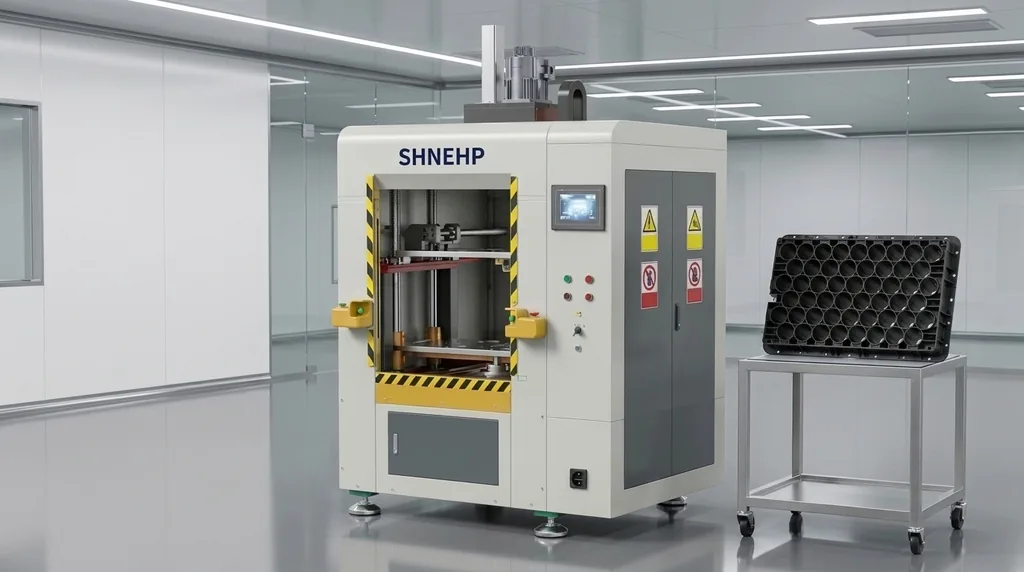
Cylindrical (18650, 21700, 4680) and prismatic lithium-ion battery modules rely on precision thermoplastic cell holders, end-plate retainers, and integrated busbar/cooling carriers to lock cell pitch tolerances, maintain high-voltage electrical creepage clearance, and resist crash vibration. Selecting hot plate welding battery cell holders fuses flame-retardant polymer carrier halves, side frames, and liquid-cooling manifold ribs simultaneously with zero mechanical vibration near sensitive battery structures. SHNEHP engineers 3-axis servo hot plate platforms (XNS5-B, XNS6-B, XNS8-B) with optional non-contact infrared (IR) heating built to DVS 2215 displacement control.
The part and its welding challenges
EV and stationary energy-storage (ESS) battery cell holders are commonly molded from UL94 V-0 flame-retardant polypropylene (PP-FR / PP-GF20–30), PC/ABS-FR, PA6/PA66-GF30, or PBT-GF. Welding intricate lattice-style cell carriers introduces five specialized manufacturing challenges:
- Tight cell-pitch & Z-height dimensional accuracy: Laser busbar welding downstream expects every cylindrical or prismatic cell pocket to sit within tight ±0.1–0.2 mm positional tolerances; uncontrolled weld collapse warps pocket alignment and breaks automated busbar welding.
- Flame-retardant (UL94 V-0) additive sensitivity: Halogen-free and brominated flame-retardant packages decompose and char easily if contact platen temperatures overshoot, narrowing the safe melt window and accelerating PTFE coating wear.
- Complex multi-rib lattice geometry: Cell holders feature dozens of thin internal honeycomb dividers and perimeter locking walls; every rib must receive balanced heat without flash spilling into tight cell insertion bores.
- Zero conductive/loose particulate contamination: Loose polymer strings or debris trapped inside cell pockets interfere with thermal-interface gap-filler dispensing and compromise high-voltage dielectric isolation.
- High glass-fiber loading (GF30–40%+): Heavily reinforced PA-GF and PBT-GF carriers cause heavy stringing on contact platens and exceed the ~270 °C PTFE durability ceiling, requiring non-contact IR heating.
Why hot plate welding (vs. alternatives)
| Process | Fit for EV/ESS battery cell holders & end carriers | Dimensional accuracy & cleanliness | Typical cycle time | Engineering boundary |
|---|---|---|---|---|
| Servo hot plate — contact & non-contact IR (XNS5-B / XNS6-B / XNS8-B) | Primary choice for multi-rib cell carriers, end-plate frames, and integrated thermal-cooling cell holders | Closed-loop 3-axis servo hard stops hold exact Z-height; non-contact IR eliminates PTFE wear and stringing on FR/GF grades | ~22–40 s (multi-cavity nests scale UPH) | Switch to non-contact IR above ~270–300 °C or GF≥40%; pre-dry PA-GF and PC/ABS-FR before welding |
| Ultrasonic welding (XNC-400 / XN-5) | Small compact 2-cell to 10-cell power-tool packs or snap-on busbar clips | Rapid sub-second localized welds | ~0.2–1.5 s | Struggles with large multi-rib EV module frames; high-frequency vibration cannot be applied once live lithium cells are loaded |
| Linear vibration friction (XN-55 / XN-70) | Heavy empty structural battery end plates or broad flat cell trays | Fast 5–15 s high-strength weld | ~5–15 s total | Linear motion requires ≥2.5–3.0 mm clearance and generates particulate dust inside honeycomb cell bores |
| Hot staking (XNR-100 / XNRZ-100) | Locking thin busbar collector plates, voltage-sensing FPCs, or thermal-pad retainers onto pre-welded cell holders | Zero vibration, clean multi-point boss retention | ~8–20 s | Fastening secondary attachments rather than continuous structural seam fusion |
Typical process window (industry ranges)
Holding tight cell-pocket geometry across flame-retardant resins demands closed-loop displacement stops and disciplined thermal ceilings. The DVS 2215 baselines below are confirmed during a SHNEHP weld trial.
| Parameter | Typical industry range (PP-FR / PC-ABS-FR / PA-GF / PBT-GF) | Engineering guidance |
|---|---|---|
| Pre-drying before welding | PC/ABS-FR & PBT-GF: 100–120 °C; PA6/66-GF: 80–90 °C | Prevents moisture foaming and preserves UL94 V-0 dielectric weld strength |
| Heating mode & temperature | Contact platen: PP-FR 245–275 °C, PC/ABS-FR 265–295 °C; Non-contact IR: 300–480 °C | Switch to non-contact IR above ~270 °C, on GF≥40%, or on heavy UL94 V-0 FR packages prone to charring |
| Bead-up / leveling (Stage 1) | 0.4–0.8 mm displacement (contact) or 1–2 mm standoff (IR) | Levels injection-molded warp across broad honeycomb cell arrays |
| Melt / soak phase (Stage 2) | 6–18 s at 0.05–0.10 N/mm² | Independent multi-zone PID heaters balance dense perimeter frames against thin internal cell ribs |
| Changeover time (Stage 3) | ≤1.5 s (PA-GF / PC-ABS / PBT) / ≤2.2 s (PP-FR) | Rapid 3-axis servo retraction stops premature skinning on fast-crystallizing PA/PBT |
| Joining & collapse (Stage 4) | 0.15–0.28 N/mm² to closed-loop servo hard stop (1.0–2.2 mm) | Hard servo stop guarantees exact Z-height for downstream automated laser busbar welding |
| Cooling / hold (Stage 5) | 6–15 s | Locks cell-pitch flatness before pneumatic release |
Recommended SHNEHP machine and fixture setup
SHNEHP applies our +60 mm fixture margin rule across our servo hot plate welding machine series for battery module manufacturing:
- Compact & medium module cell holders: XNS5-B and XNS6-B 3-axis full-servo hot plate welders deliver tight closed-loop collapse precision and multi-zone PID control for cylindrical and prismatic cell carriers.
- Large CTP/module carriers & twin-cavity tooling (up to ~850×800 mm): XNS8-B and XNS9-B heavy-duty servo platforms support broad honeycomb fixtures with zero platen deflection.
- Non-contact infrared heating head: Strongly recommended for UL94 V-0 flame-retardant grades and PA-GF35/40 carriers to eliminate platen contact, PTFE coating buildup, and stringing inside cell pockets.
- Pitch-locating fixtures & automated cells: Custom welding and testing fixtures integrate hardened multi-pin cell-pitch datum locators, vacuum flat-clamping nests, and MES barcode traceability via customized machines.
Quality inspection and process control
Battery cell holders combine dimensional metrology, mechanical pull verification, and (where cooling channels are integrated) inline leak testing:
- 100% closed-loop weld telemetry: Per-cycle logging of every PID heating zone, changeover duration, servo meltdown depth, and closing force feeds directly into EV battery-pack MES traceability records.
- Cell-pitch & Z-height gauging: Automated go/no-go pin gauges or vision stations confirm cell pocket concentricity, zero flash intrusion inside cell bores, and exact finished module height for robotic cell loading.
- Integrated cooling-channel leak testing (when applicable): Cell holders incorporating liquid-cooling micro-channels undergo 100% inline pressure-decay testing (50–150 kPa, 1–5 mL/min, 2–5 s stabilization) with post-weld cooling buffers.
- Destructive tensile & vibration audits: Lot samples undergo pull-apart weld testing, cross-section void inspection, and pack-level vibration qualification.
FAQ
Why is non-contact infrared (IR) hot plate welding often chosen for UL94 V-0 battery cell holders? Flame-retardant additives and high glass-fiber percentages (GF30–40%) degrade contact PTFE coatings quickly and cause melt stringing inside cell pockets. Non-contact IR heating eliminates physical platen contact, preventing residue buildup and particulate contamination.
How does servo hot plate welding hold tight cell-pitch tolerances for downstream laser busbar welding? Hardened multi-pin datum fixtures locate both cell-holder halves precisely while 3-axis closed-loop servo displacement stops control final weld collapse to micron-class repeatability, preventing Z-height drift and pocket warp.
Can battery cell holders be welded after lithium cells are inserted, or before? Empty thermoplastic cell-holder sub-assemblies and cooling carriers are welded prior to cell loading (avoiding thermal exposure to live cells), whereas secondary busbar/FPC clip fastening on loaded packs typically uses localized low-heat mechanical staking or snap-fit designs.
When should battery cell holders use hot plate welding versus ultrasonic welding? Use servo hot plate welding (XNS5-B / XNS6-B / XNS8-B) for medium-to-large EV/ESS multi-rib cell holders, semi-crystalline PP-FR/PA-GF grades, and integrated cooling carriers. Use ultrasonic welding (XNC-400) only for small rigid compact packs or auxiliary clips.
What files should we send for a SHNEHP battery cell holder weld trial? Share frozen 3D STEP/X_T models showing all cell-pocket keep-out zones, exact UL94 V-0 resin and GF percentage, required Z-height tolerance, and target hourly output (UPH).
Get a free weld trial
Send your EV or ESS battery cell-holder CAD files to SHNEHP engineering to evaluate contact versus non-contact IR servo hot plate welding and pitch-datum fixture design:
- Frozen 3D STEP / X_T / IGES models of the cell holder and end frames
- Resin, GF %, and UL94 V-0 spec (PP-FR, PC/ABS-FR, PA66-GF, PBT-GF)
- Target hourly output (UPH) and cell-pitch / Z-height tolerance
Email yy@nbxiaoneng.com or reach our team on our contact page.
Request a Technical Consultation & Free Weld Trial
Send your 3D STEP/X_T drawing, resin grade, target cycle time, and leak-test specification. Our engineers will evaluate the joint and recommend a practical SHNEHP machine and fixture setup.