
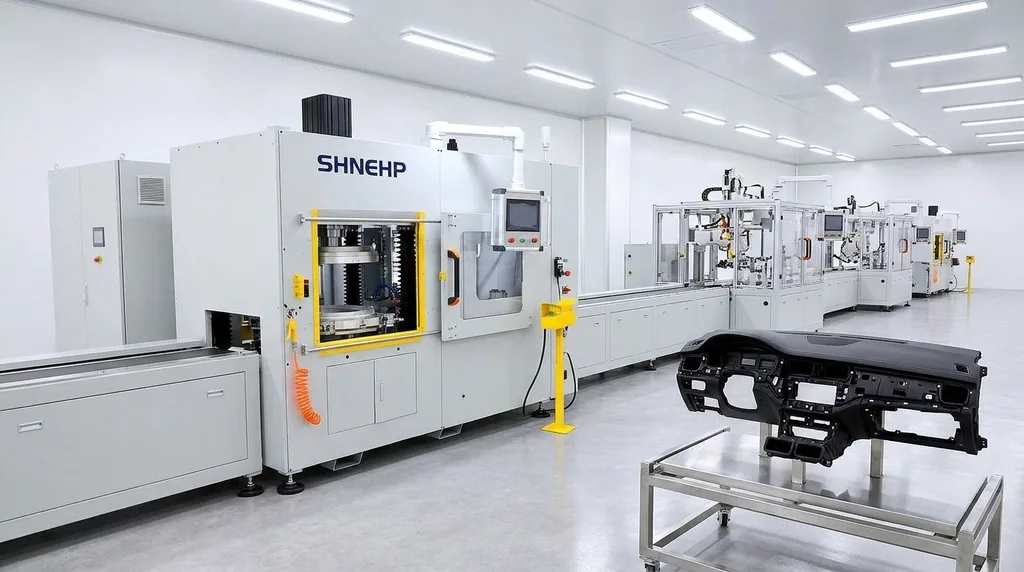
Modern EV and passenger-car instrument panels (dashboards) are massive 1.4–1.7 meter multi-material cockpit modules integrating structural PP-GF / PP-LGF / PC-ABS carriers, passenger airbag deployment chutes, multi-branch HVAC defroster air ducts, glove-box housings, digital display bezels, and soft-touch leather/TPO-wrapped Class-A skins. Assembling 40 to 90 joining points per cockpit across separate manual presses consumes huge floor space, causes cosmetic handling scuffs, and puts safety-critical passenger airbag chute traceability at risk. Deploying custom automation instrument panel welding consolidates vibration welding, hot-air cold staking, ultrasonic punching/welding, vision poka-yoke, and serialized MES logging into one synchronized Tier-1 cockpit line. SHNEHP builds turnkey customized machines around our in-house hot plate, vibration, hot staking, and ultrasonic platforms.
The part and its welding challenges
Cockpit and dashboard assembly cells balance tight OEM vehicle-sequencing takt times (45–90 seconds per IP) against five exacting interior-safety challenges:
- Safety-critical passenger airbag (PAB) chute welding traceability: The passenger airbag chute bonded to the underside of the dashboard skin is a life-safety joint—every weld point must log force, displacement, temperature, or energy to the cockpit VIN/serial number with zero-escape poka-yoke interlocks.
- Combining four distinct plastic-joining physics in one balanced takt: A single instrument panel routinely needs linear vibration welding (for the large PAB chute or structural glove-box/duct sub-carrier), multi-point hot-air cold staking (30–60 bosses attaching trim bezels and brackets without damaging soft-touch skins), hot plate welding (for 3D HVAC defroster air ducts), and 30–35 kHz ultrasonic welding/punching (for ambient light pipes and display clips).
- Zero Class-A skin damage across 1.6-meter spans: Soft-touch slush-molded TPO, stitched synthetic leather, and piano-black trim inserts cannot tolerate clamping witness marks or dust transfer during multi-station pallet indexing.
- High-mix LHD/RHD and trim-level sequencing: One vehicle architecture ships in left-hand-drive, right-hand-drive, HUD/non-HUD, and standard/luxury speaker configurations; automated cells must toggle active staking/ultrasonic heads dynamically from the broadcast barcode.
- Strict buzz-squeak-rattle (BSR) dimensional repeatability: Cockpit modules must drop cleanly onto cross-car beams without gaps or rattles, requiring rigid datum transfer between welding and final vision/clip-presence verification.
Why turnkey instrument panel automation (vs. alternatives)
| Architecture | Fit for Tier-1 automotive cockpit & IP plants | Safety traceability & BSR quality | Typical line takt | Engineering boundary |
|---|---|---|---|---|
| SHNEHP turnkey multi-station / robotic IP line | Optimal choice for medium-to-high-volume vehicle dashboards and center consoles (80k–500k+ IPs/year) | Single-vendor accountability across vibration, hot-air staking, hot plate, ultrasonic, vision poka-yoke, and MES VIN binding | ~45–90 s/cockpit | Requires frozen BIW datum scheme and LHD/RHD quick-change pallet strategy |
| Multi-head dual-shuttle hot-air staking + ultrasonic cell | Dedicated high-mix dashboard trim and bezel sub-assembly | High flexibility for 30–60+ discrete bosses with zero vibration near HUD/screen mounts | ~35–65 s/panel | Pairs alongside an upstream vibration or hot-plate press for large continuous ducts/chutes |
| Standalone manual stations with operator transfers | Low-volume specialty vehicles or early pre-series pilot runs | Lower initial capital investment | ~120–240 s/IP | High labor count, elevated Class-A scratch risk, and fragmented PAB safety audit logs |
| Multi-vendor piecemeal integration | Legacy cockpit line retrofits | Reuses legacy presses | Variable | Difficult cycle synchronization and split accountability during OEM PPAP sign-off |
Typical process window (industry ranges)
Turnkey instrument panel lines synchronize DVS 2215 / DVS 2217 structural stations with multi-point thermal and acoustic finishing stations. Exact station count and robot work-envelope are simulated around your cockpit CAD during SHNEHP proposal design.
| Cockpit Line Station | Integrated Operations | Engineering Control Standard |
|---|---|---|
| Station 1: Carrier Load & Component Poka-Yoke | Barcode/VIN scan; optical/vision verification of ducts, clips, sound-deadening pads, and PAB chute | Interlock halts line immediately if any sub-part or trim variant mismatches broadcast order |
| Station 2: Structural Duct & PAB Chute Welding | XN-70 / XN-100 / XN-200 linear vibration (or XNS8-B/9-B hot plate for 3D HVAC ducts) | Two-stage pressure for PP-GF/PA-GF; 100% closed-loop meltdown & curve upload to MES |
| Station 3: Multi-Point Hot-Air Cold Staking | 20–60 simultaneous servo/pneumatic hot-air nozzles + instant cold-air staking punches | Zero Class-A read-through on wrapped/slush skins; zero vibration near display brackets |
| Station 4: Robotic 30–35 kHz Ultrasonic Finishing | 6-axis robot with multi-angle ultrasonic weld/punch EOAT for ambient light bars, sensor mounts, and HUD bezels | Dynamic trim-recipe selection (base vs. HUD vs. luxury audio); energy + depth dual gating |
| Station 5: Final Vision, Clip Check & MES Sign-Off | Automated camera verification of all clips, foam seals, and cosmetic trim flushness | Generates serialized pass label & full PPAP/MES database record per cockpit |
Recommended SHNEHP machine and fixture setup
SHNEHP manufactures all core joining technologies and cockpit-scale automation in-house inside our customized machines division:
- Core welding & staking platforms: Seamless multi-station integration of XN-70 / XN-100 / XN-200 vibration friction welders, XNS8-B / XNS9-B wide-bed hot plate welders, multi-zone hot staking machines, and robotic 20–35 kHz ultrasonic welding units.
- Class-A cockpit pallet carriers & SMED tooling: Felt/urethane-lined vacuum nests mounted on rigid precision-indexed shuttles or overhead gantry transfers, engineered as custom welding and testing fixtures with quick-change LHD/RHD inserts.
- Centralized PLC & safety-grade MES logging: Unified Siemens/Mitsubishi PLC line architecture storing per-point weld curves, hot-air nozzle temperatures, and vision images via OPC-UA / SQL directly to Tier-1 MES.
Quality and leak testing
Cockpit automation cells enforce multi-layered safety and NVH verification on every assembled instrument panel:
- Safety-critical PAB chute & BSR weld monitoring: Every vibration weld, hot-air stake, and ultrasonic spot enforces strict upper/lower displacement, temperature, and energy limits—automatically locking suspect panels for containment before pack-out.
- HVAC duct airflow/leak verification: Integrated low-pressure duct leak stations (2–15 kPa) check welded defroster and cabin vent channels for zero whistle-inducing gaps before final cockpit trim installation.
FAQ
Can SHNEHP combine vibration welding, hot-air cold staking, and robotic ultrasonic welding in one instrument panel line? Yes. Because SHNEHP designs and builds vibration, hot plate, hot staking, and ultrasonic equipment in-house, we deliver fully unified multi-station cockpit cells with one PLC/HMI and single-vendor FAT responsibility.
How does an automated IP line protect wrapped leather or soft-touch slush-molded dashboard skins from weld marks? Class-A show surfaces rest on contoured felt/urethane vacuum cradles with active cooling support, while rear attachment bosses are joined via localized hot-air cold staking or 30–35 kHz low-amplitude ultrasonics that keep heat away from the show skin.
How are passenger airbag (PAB) chute welds tracked for automotive safety audits? Every cockpit carrier is scanned at Station 1, and every individual PAB weld curve (displacement, force, time, or energy) plus vision confirmation is archived automatically under that exact panel serial number in the plant MES.
Can one SHNEHP cockpit automation cell run both left-hand-drive (LHD) and right-hand-drive (RHD) instrument panels? Yes. Modular quick-change shuttle nests with RFID tool identification and programmable robot/head-activation recipes switch cleanly between LHD, RHD, HUD, and standard trim levels.
What engineering information do you need to propose a custom instrument panel welding line? Send 3D STEP/X_T assemblies of the cockpit carrier, ducts, PAB chute, and trim bezels, joining-point count and resins (PP-T20, PP-GF, PC/ABS), LHD/RHD variants, target takt time, and MES requirements.
Get a free weld trial
Share your instrument panel or center-console CAD assemblies with SHNEHP automation engineering to receive a 3D cell layout, process-assignment matrix, cycle balance chart, and sample weld trials:
- 3D STEP / X_T / IGES models of IP carrier, ducts, PAB chute, and bezels
- Polymer grades & Class-A skin specs (PP-T20, PP-GF, TPO slush, wrapped leather)
- Annual volume, target takt time, and LHD/RHD variant list
Email yy@nbxiaoneng.com or request a turnkey cockpit proposal via our contact page.
Request a Technical Consultation & Free Weld Trial
Send your 3D STEP/X_T drawing, resin grade, target cycle time, and leak-test specification. Our engineers will evaluate the joint and recommend a practical SHNEHP machine and fixture setup.