
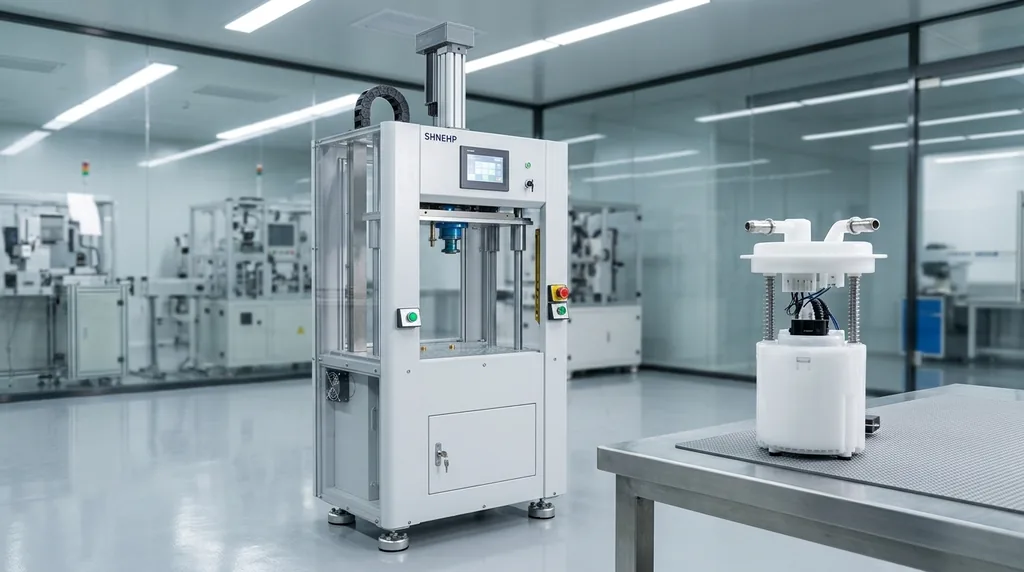
In-tank automotive fuel delivery modules (FDMs)—used across ICE and plug-in hybrid (PHEV) vehicles—integrate high-pressure electric fuel pumps, jet-pump venturi swirl pots, pressure regulators, fuel-level senders, and vapor-tight top flange plates submerged directly in gasoline, ethanol blends (E85), or diesel fuel. Selecting vibration welding fuel pump module equipment fuses chemical-resistant POM and PA12 top-flange covers, swirl-pot chambers, and integrated inline fuel-filter housings cleanly in 5–12 seconds without POM overheating risks or elastomer seal aging. SHNEHP engineers high-frequency (210–270 Hz) linear vibration platforms (XN-15, XN-35, XN-40) built to DVS 2217 meltdown control.
The part and its welding challenges
Fuel pump modules and in-tank swirl-pot reservoirs are predominantly molded from fuel-impermeable POM (acetal homopolymer/copolymer), PA12 / PA66-GF, conductive POM/PA (for electrostatic grounding inside the fuel tank), or HDPE. Welding safety-critical fuel-delivery sub-assemblies presents five demanding engineering challenges:
- POM thermal-decomposition safety advantage of vibration welding: Acetal (POM) decomposes rapidly and emits irritating formaldehyde fumes if overheated on a hot plate; fast, self-limiting 2–4 second frictional vibration welding generates melt strictly at the microscopic joint interface with minimal thermal degradation—still paired with standard local fume extraction.
- Zero-leak EVAP top-flange & fuel-line pressure containment: The upper module flange seals the tank opening against evaporative hydrocarbon emissions, while integrated high-pressure filter chambers operate at 4–6+ bar continuous pump delivery pressure.
- Protecting internal fuel-level senders, wiring & check valves: Swirl-pot reservoirs hold delicate fuel-level potentiometer cards, flexible corrugated hoses, and venturi check valves; linear vibration is performed on empty structural sub-housings or with precision fixture isolation before final sensitive electronics loading.
- Clean-side particulate control downstream of the high-pressure filter: Enclosed inner flash traps and high-frequency small-amplitude vibration (210–270 Hz) prevent loose POM/PA dust from entering the clean fuel-rail outlet.
- Asymmetrical SAE quick-connect ports & electrical bulkhead headers: Module flanges carry angled fuel supply/return fittings and multi-pin electrical connectors that block rotational spin welding, making linear vibration ideal.
Why vibration friction welding (vs. alternatives)
| Process | Fit for fuel pump modules, flanges & swirl-pot chambers | Chemical burst & POM safety | Typical cycle time | Engineering boundary |
|---|---|---|---|---|
| Linear vibration friction (210–270 Hz: XN-15 / XN-35 / XN-40) | Primary choice for POM, PA12, and PA66-GF fuel-pump top flanges, integrated filter chambers, and jet-pump swirl-pot bases | Self-limiting interfacial friction avoids bulk POM overheating; high 4–6+ bar burst strength on asymmetrical flanges | ~5–12 s total (1.5–4 s weld) | Requires ≥2.5–3.0 mm clearance and matched compatible polymers (POM-to-POM, PA-to-PA); isolate delicate sender electronics |
| Spin welding (XNX-100 / XNX-200) | Purely circular single-cavity in-tank filter canisters or round pressure-regulator caps | Ultra-fast 0.5–3 s circular fusion (3–15 m/s surface speed) | ~0.5–3 s weld | Blocked by offset SAE ports, guide-rod bosses, and electrical connector bulkheads on top flanges |
| Servo hot plate welding (XNS5-B / XNS6-B) | Deep 3D-contoured HDPE/POM baffle sub-assemblies where in-plane motion is obstructed | Zero friction dust, deep 3D contour reach | ~20–35 s total | POM requires strict upper-temperature interlocks and fume extraction to avoid thermal decomposition |
| Ultrasonic welding (XNC-400 / XN-3) | Small internal check valves, wire clips, and level-sender float retainers | Sub-second local welds | ~0.1–1.2 s | Insufficient burst safety margin on larger pressurized POM/PA fuel-filter module flanges |
Typical process window (industry ranges)
The conservative DVS 2217 linear vibration baselines below cover POM (acetal), PA12, and PA66-GF automotive fuel pump module sub-assemblies. Exact meltdown stops and pressure profiles are verified during a SHNEHP weld trial.
| Parameter | Typical industry range (POM / PA12 / PA66-GF) | Engineering guidance |
|---|---|---|
| Operating frequency | 210–270 Hz (high-frequency electromagnetic drive) | Compact amplitude (0.5–0.9 mm) minimizes clearance around SAE fuel ports and limits particulate generation |
| Wall & flash-trap design | Flange wall ≥2.5–4.0 mm with enclosed inner clean-side flash trap; ≥2.5–3.0 mm clearance | Prevents POM/PA flash dust from entering the high-pressure fuel outlet passage |
| Weld pressure | POM: 1.5–3.5 N/mm²; PA12 / PA66-GF: 1.5–4.0 N/mm² (staged down slightly at final collapse on GF grades) | Ensures full 360° fusion without cracking adjacent SAE port roots |
| Weld time & meltdown | 1.5–4.5 s to closed-loop meltdown target 1.0–1.8 mm | Displacement stop guarantees exact guide-rod alignment and O-ring flange flatness |
| Hold / cooling dwell | 1.5–4.0 s under clamping load | Locks crystalline POM/PA12 fusion tightly with zero flange warpage |
Recommended SHNEHP machine and fixture setup
SHNEHP matches compact high-frequency vibration friction welding machines to your fuel pump module's effective weld area and port-clearance envelope:
- Single-cavity fuel-filter chambers & compact flanges (area ≤120 cm², upper tool ≤15 kg): XN-15 high-frequency platform offers compact clean-line footprint and micron-class meltdown accuracy.
- Full top-flange assemblies, swirl pots & twin-cavity fixtures (area ≤250–300 cm², upper tool ≤35–40 kg): XN-35 and XN-40 high-frequency platforms deliver rigid clamping, sound enclosures, and local fume-extraction ports for POM processing.
- Port-relieved steel fixtures & EVAP test cells: Custom welding and testing fixtures integrate deep clearance pockets for SAE fuel nipples and electrical bulkheads, paired with automated inline high-pressure and EVAP differential leak stations via customized machines.
Quality and leak testing
Fuel pump modules enforce strict dual-tier leak verification covering both high-pressure fuel delivery and low-pressure EVAP vapor containment:
- 100% inline pneumatic pressure-decay testing: High-pressure filter chambers test at 100–300 kPa (1.0–3.0 bar) with 1–5 mL/min limits using locking pneumatic port clamps, while EVAP vapor passages test at 10–35 kPa / 0.1–0.5 mL/min via 1 Pa differential pressure decay (or helium mass spectrometry where OEM limits fall below <0.05 mL/min).
- Hydrostatic burst & E85 fuel-soak audits: Batch samples undergo high-pressure burst verification, ethanol-blend thermal-soak aging, and clean-side particulate extraction audits.
FAQ
Why is linear vibration welding often safer than hot plate welding for POM (acetal) fuel pump modules? POM decomposes rapidly if exposed to excessive hot-plate temperatures or prolonged soak dwell. High-frequency linear vibration welding melts strictly the interfacial seam in 1.5–4.5 seconds with minimal bulk heating, producing strong pressure-tight joints cleanly (still paired with standard fume extraction).
Can you vibration weld a POM fuel-pump flange to an HDPE fuel tank directly? No. POM and HDPE are chemically incompatible polymers and cannot directly form a molecular weld. Vibration welding joins matched-grade POM-to-POM or PA-to-PA fuel pump module components; the assembled flange locks onto the tank via a threaded lock-ring and elastomer seal (or matched HDPE adapter ring).
How do you protect angled SAE quick-connect ports and electrical pins during vibration welding? CNC-machined steel upper and lower nests feature full relief pockets around SAE ports and bulkhead connectors while gripping structural flange shoulders and molded anti-rotation lugs firmly.
What leak-test thresholds apply to automotive fuel pump modules? Pressurized in-module filter chambers typically test at 100–300 kPa (1–5 mL/min) while EVAP vapor sealing tests at 10–35 kPa (0.1–0.5 mL/min) via 1 Pa differential pressure decay (upgrading to helium leak testing for sub-0.05 mL/min permeation specs).
What files should we send for a SHNEHP fuel pump module weld trial? Share frozen 3D STEP/X_T models showing all SAE ports, electrical headers, and clean-side filter chambers, exact POM/PA12/PA66-GF grade, target UPH, and OEM burst and EVAP leak-test specs.
Get a free weld trial
Send your fuel pump module CAD drawings to SHNEHP engineering to evaluate XN-15 / XN-35 / XN-40 linear vibration tooling, port-relief fixtures, and dual-tier leak testing on a free weld trial:
- Frozen 3D STEP / X_T / IGES models of the flange, swirl pot, and filter housing
- Polymer grade & conductive spec (POM, conductive POM, PA12, PA66-GF)
- Target hourly output (UPH), hydrostatic burst target, and EVAP leak specification
Email yy@nbxiaoneng.com or connect through our contact page.
Request a Technical Consultation & Free Weld Trial
Send your 3D STEP/X_T drawing, resin grade, target cycle time, and leak-test specification. Our engineers will evaluate the joint and recommend a practical SHNEHP machine and fixture setup.