
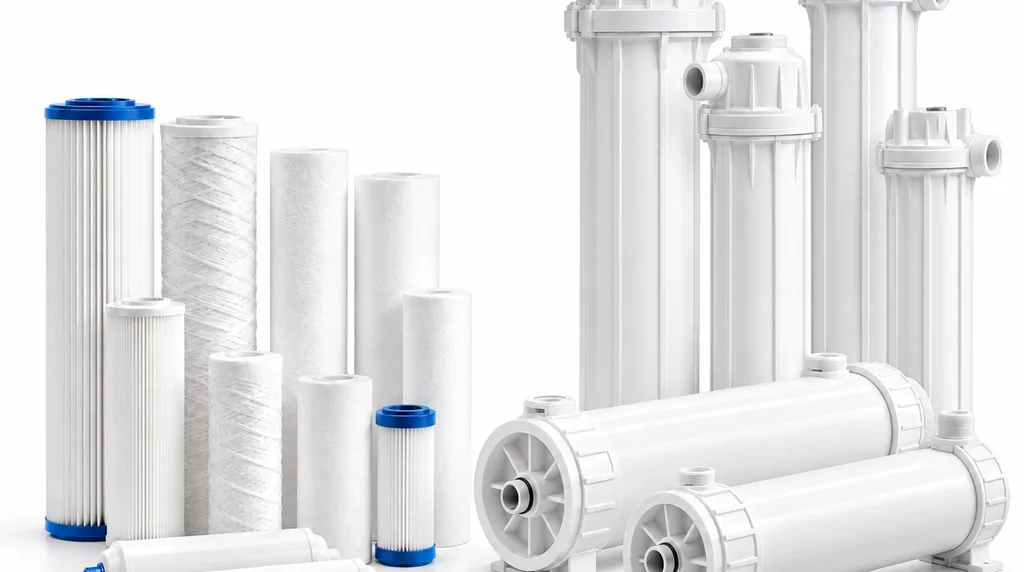
Under-sink residential reverse-osmosis (RO) water purifiers, quick-twist disposable RO membrane cartridges, and commercial multi-element RO pressure vessels operate under continuous 400–800 kPa (4–8 bar) booster-pump pressure and relentless water-hammer valve cycling inside customer kitchens and offices. A single micro-leak along a hot-plate or spin-welded PP, PP-GF, ABS, or PPE/PPO RO housing seam can flood cabinetry overnight and trigger costly warranty claims. Purpose-built leak testing fixture ro membrane housings stations test 100% of welded RO pressure vessels inline using clean, dry, food-contact-safe compressed air—checking both outer pressure-vessel integrity and internal permeate-to-concentrate O-ring/seal-lip bypass in seconds with zero messy wet-testing contamination. SHNEHP engineers multi-channel pneumatic welding and testing fixtures built for high-volume water-purification OEMs.
The part and its welding challenges
Welded RO membrane cartridges and pressure vessels combine thick cylindrical pressure walls with concentric multi-port quick-connect fittings, creating five specialized leak-testing hurdles:
- High-pressure safe pneumatic containment (300–600+ kPa): Testing pressurized RO vessels at 100–300 kPa (standard inline dry-air) up to 500–800 kPa (high-pressure proof/decay) generates substantial axial blow-off force on end caps; fixtures require rigid steel/aluminum tie-bar clamping and safety light-curtain interlocks so a faulty cold-welded vessel can never eject during pressurization.
- Simultaneous multi-port concentric sealing (Feed, Permeate & Brine): Quick-twist RO membrane cartridges feature triple concentric ports or three barbed/John-Guest push-fit nipples on one end cap; precision coaxial silicone radial sealing mandrels plug all three channels rapidly without marring food-grade quick-connect surfaces.
- Separating outer-housing leaks from internal permeate-to-brine cross-leaks: Inside an encapsulated RO cartridge, raw feed water must never bypass the spiral-wound RO membrane directly into the clean drinking-water permeate tube; multi-channel valve logic checks both external shell airtightness and internal O-ring/weld isolation in one cycle.
- 100% food-grade oil-free dry-air cleanliness (zero water stagnation): Testing drinking-water RO membranes in dirty water tanks risks microbial growth and soggy packaging; SHNEHP dry-air benches run filtered, oil-free instrument air (0.01 µm filtration) so finished RO cartridges pack straight into clean shrink-wrap.
- High-volume multi-cavity balancing (2 to 4 vessels per station): Large water-purifier OEMs run 1,000–5,000+ RO cartridges per shift, requiring dual- or quad-station parallel leak fixtures matched directly to upstream XNS5-B / XNS6-B hot plate or XNX-100 / XNX-200 spin welders.
Why custom dry-air RO leak testing fixtures (vs. alternatives)
| Method | Fit for inline RO membrane housings & encapsulated cartridges | Food-grade cleanliness, safety & cycle speed | Typical cycle time | Engineering boundary |
|---|---|---|---|---|
| SHNEHP multi-channel dry-air differential / pressure-decay fixture | Standard OEM inline choice for 100% testing of welded RO housings and quick-twist cartridges | Oil-free clean air (zero water drying or bacteria risk); tests 100–300 kPa (or up to 600+ kPa proof) + 1–5 mL/min quantitative MES logging | ~12–25 s (2–4 vessels parallel) | Requires rigid axial containment clamps and thermal stabilization right after hot plate welding |
| Hydrostatic burst / cyclic water-hammer rig (offline) | NSF/ANSI 58 qualification & batch audit testing | Validates 100,000-cycle water-hammer fatigue and 2.5–3.5 MPa burst safety margin | ~15–60 min/audit | Destructive offline sampling only—never for 100% inline shipping cartridges |
| Water immersion bubble tank | Offline root-cause leak localization on rejected empty shells | Pinpoints exact seam leak spot visually | ~60–120 s + drying | Unhygienic for drinking-water RO cartridges; leaves trapped moisture inside cartridges |
| Manual hand-threaded bench gauges | Early prototype validation | Minimal upfront fixture cost | ~60–120 s/part | Slow, inconsistent torque sealing, and zero poka-yoke traceability |
Typical process window (industry ranges)
RO membrane housing leak stations pair oil-free high-flow filling with rigid axial safety clamping and calibrated master-leak verification. Exact test pressures scale to whether an empty RO vessel or a loaded dry-membrane cartridge is tested.
| Parameter | Typical industry range (RO Membrane Housings & Cartridges) | Engineering guidance |
|---|---|---|
| Standard inline dry-air test pressure | 100–300 kPa (1.0–3.0 bar) standard; up to 500–600 kPa for high-pressure proof/decay rigs | High-rigidity enclosed safety guard mandatory above 300 kPa pneumatic pressure |
| Allowable leak-rate threshold | 1–5 mL/min (or tighter 0.2–1.0 mL/min for premium export cartridges) | Verified daily with an onboard certified standard leak master orifice |
| Internal bypass check | Independent feed-to-permeate differential check (loaded cartridges) | Catches pinched internal brine/permeate O-rings before shipment |
| Fill, stabilize & measure | Fill 3–6 s; stabilize 4–8 s; measure 4–8 s | Dual- or quad-nest parallel fixtures keep effective takt down to 4–8 s per cartridge |
| Air quality standard | Food-contact oil-free filtered instrument air (≤0.01 µm, dry dew point) | Protects drinking-water NSF/ANSI 58 hygiene inside sealed cartridges |
Recommended SHNEHP machine and fixture setup
SHNEHP builds standalone and welder-integrated welding and testing fixtures specifically for residential and commercial water-treatment plants:
- 2-station & 4-station parallel RO leak benches: Independently instrumented test channels evaluate 2 to 4 RO membrane housings concurrently inside a polycarbonate-guarded frame, matching the exact output of upstream SHNEHP XNS5-B / XNS6-B hot plate or XNX-100 / XNX-200 spin welders.
- Quick-change cartridge length & bayonet tooling: Adjustable servo/indexed tailstocks and snap-in silicone coaxial mandrels let one leak-test station accommodate 400G, 600G, 800G, 1000G, and 1200G RO cartridge lengths in under 5 minutes.
- Turnkey inline automation & laser marking: Seamlessly connects via conveyor to welding presses inside customized machines, binding every RO housing's serial barcode to its weld and pressure-decay record and locking out rejects automatically.
Quality and leak testing
Water-purifier OEM lines rely on automated Gage R&R verification and poka-yoke containment:
- Shift-start calibrated master leak & blockage checks: Every channel runs an automated golden-part and certified-orifice check at shift startup while monitoring port flow continuity on every cycle to stop flash-blocked nipples from passing falsely.
- Zero-escape reject segregation: Failed RO vessels remain locked in the nest or drop straight into a locked red reject bin—never reaching final laser coding or carton pack-out.
FAQ
What air pressure and leak-rate limit are typically used to inline-test welded RO membrane housings? Standard inline dry-air stations test welded RO membrane housings at 100–300 kPa (1.0–3.0 bar) against a 1–5 mL/min threshold (tighter 0.2–1.0 mL/min or higher 500–600 kPa proof/decay pressures where specified by OEM export standards).
Can a dry-air leak fixture test a quick-twist RO cartridge with concentric feed, permeate, and brine ports? Yes. SHNEHP machines food-grade silicone coaxial radial sealing mandrels that simultaneously plug and isolate all concentric ports in 1 second without scratching quick-connect O-ring seating bores.
Why is dry-air leak testing preferred over water dunk testing for drinking-water RO cartridges? Dry oil-free instrument air keeps finished RO membrane elements completely dry and sterile—eliminating bacterial growth risks, drying oven energy, and wet shipping cartons while delivering quantitative mL/min traceability.
Can one SHNEHP leak fixture adjust across multiple RO cartridge lengths (e.g., 400G to 1200G)? Yes. Indexed pneumatic/servo tailstocks and quick-change silicone sealing noses allow one multi-channel test bench to switch smoothly across an entire family of residential and commercial RO cartridge diameters and lengths.
What CAD data should we send for an RO membrane housing leak-testing fixture quote? Provide 3D STEP/X_T models of the RO housing and port geometry, cartridge diameter/length range, empty vs. loaded-membrane test sequence, target pressure/leak limit, and required hourly output.
Get a free weld trial
Share your RO membrane housing or quick-twist cartridge CAD models with SHNEHP engineering to design a fast, food-grade multi-channel dry-air leak-testing fixture—standalone or linked directly with your hot plate or spin welder:
- 3D STEP / X_T / IGES models of RO pressure vessel, end cap, and coaxial ports
- Test spec (pressure kPa, allowable mL/min, internal bypass test requirements)
- Cartridge size family (400G–1200G+) & target hourly output (UPH)
Email yy@nbxiaoneng.com or connect through our contact page.
Request a Technical Consultation & Free Weld Trial
Send your 3D STEP/X_T drawing, resin grade, target cycle time, and leak-test specification. Our engineers will evaluate the joint and recommend a practical SHNEHP machine and fixture setup.