
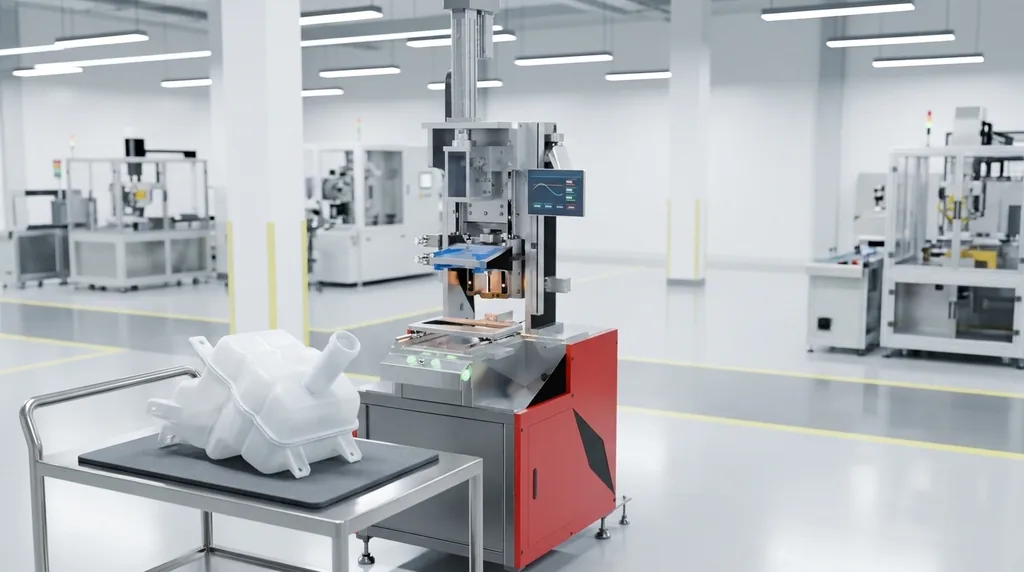
Automotive windshield and headlamp washer fluid reservoirs fit tightly inside cramped front-fender wheel wells, combining irregular L-shaped or sculpted 3D silhouettes, integrated pump-grommet pockets, level-sensor bosses, and long filler necks. Choosing hot plate welding washer bottle production lets Tier-1 and Tier-2 fluid-system suppliers join injection-molded HDPE or PP halves with uniform wall thickness, molded-in mounting tabs, and lower unit cost than complex blow-molding setups. SHNEHP engineers 3-axis servo (XNS5-B, XNS6-B, XNS8-B) and heavy-duty pneumatic (XN-400P, XN-600P) hot plate welders built to DVS 2215 reliability.
The part and its welding challenges
Windshield washer bottles are typically molded from chemical- and freeze-resistant HDPE or copolymer PP (capable of withstanding methanol/ethanol winter antifreeze mixtures and -40 °C freeze expansion). Welding irregular automotive washer reservoirs presents five practical manufacturing hurdles:
- Sculpted 3D wheel-well contours: Washer bottles curve around bumper crash cans and wheel arches; mating seams frequently step across multiple planes, requiring precision CNC-contoured heating platens.
- Sub-zero freeze-thaw & chemical stress resistance: Freezing washer fluid expands sharply inside trapped corners, while alcohol-based winter fluids accelerate environmental stress cracking along weak cold-weld joints.
- Integrated pump pocket & mounting-ear dimensional accuracy: Molded mounting brackets and rubber pump-grommet bores must maintain tight positional tolerances after weld meltdown so bottles bolt onto the chassis cleanly without pre-load stress.
- High-volume cost competitiveness: Washer tanks are high-volume automotive commodity components where machine uptime, long PTFE non-stick life, and fast dual-cavity cycling directly protect supplier margins.
- Post-weld thermal stabilization before leak screening: Freshly welded HDPE/PP bottles retain significant heat; testing immediately off the platen without a cooling buffer triggers false leak alarms.
Why hot plate welding (vs. alternatives)
| Process | Fit for automotive windshield washer bottles | Geometry & cost efficiency | Typical cycle time | Engineering boundary |
|---|---|---|---|---|
| Servo / pneumatic hot plate welding (XNS5-B / XNS6-B / XN-400P / XN-600P) | Industry standard for 3D-contoured injection-molded HDPE and PP washer reservoirs and filler-neck attachments | Joins complex sculpted halves with integrated mounting ears, baffles, and consistent wall thickness | ~22–38 s (2-cavity nests double hourly output) | Keep wall ≥1.8–2.5 mm, PTFE contact ≤270 °C, and changeover ≤2.5 s for HDPE/PP |
| Blow molding (single-piece) | Simple high-volume hollow bottles without internal baffles | No welding seam | Blow-molding cycle | Thin uneven corners, limited molded mounting-bracket precision, and still requires secondary hot-plate/spin welding for ports & filler necks |
| Linear vibration friction (XN-55 / XN-70) | Strictly planar, rigid thick-walled tanks | Fast 6–15 s cycle | ~6–15 s total | Cannot follow deep 3D fender contours and thin flexible HDPE walls absorb vibration energy easily |
| Spin welding (XNX-100) | Attaching circular filler-neck spouts or round sensor ports onto blow-molded bottles | 0.5–3 s circular spout fusion | ~0.5–3 s weld | Strictly limited to round circular ports—cannot join two-shell sculpted bottles |
Typical process window (industry ranges)
The conservative DVS 2215 five-stage baselines below cover HDPE and copolymer PP automotive washer reservoirs. Final cycle parameters are confirmed during a SHNEHP part-specific weld trial.
| Parameter | Typical industry range (HDPE / Copolymer PP) | Engineering guidance |
|---|---|---|
| Platen face temperature | HDPE: 225–255 °C; PP: 245–275 °C | Well below the ~270 °C PTFE coating ceiling for long multi-shift anti-stick service life |
| Bead-up / leveling (Stage 1) | 0.6–1.0 mm displacement | Compensates for molded rim warp across L-shaped sculpted bottle halves |
| Melt / soak phase (Stage 2) | 8–16 s at 0.05–0.10 N/mm² | Uniform melt film ensures freeze-crack toughness along sharp bottle corners |
| Changeover time (Stage 3) | ≤2.0–2.5 s | Fast platen retraction avoids cooling skin formation before closing |
| Joining & collapse (Stage 4) | 0.15–0.28 N/mm² to hard displacement stop (1.5–2.5 mm) | Repeatable collapse preserves exact chassis mounting-ear hole pitch |
| Cooling / hold (Stage 5) | 8–15 s under clamping load | Locks HDPE/PP seam flat and stress-free prior to ejection |
| Total cycle time | ~22–38 s (twin-cavity fixtures scale easily to high OEM UPH) | Smoothly pairs with inline cooling conveyor and air-decay leak tester |
Recommended SHNEHP machine and fixture setup
Applying our +60 mm clearance rule across our hot plate welding machine range, SHNEHP offers both servo precision and cost-optimized pneumatic configurations for automotive fluid reservoirs:
- High-precision Tier-1 OEM programs: XNS5-B, XNS6-B, and XNS8-B 3-axis full-servo hot plate welders offer closed-loop collapse stops, per-cycle traceability logging, and rapid recipe changeover across vehicle platforms.
- Cost-optimized high-volume commodity programs: XN-400P and XN-600P heavy-duty pneumatic hot plate welders deliver dependable mechanical hard-stop accuracy and rugged multi-shift durability.
- Quick-change contour nests & inline testing: Custom welding and testing fixtures pair vacuum-assisted aluminum nests with post-weld cooling racks and inline dry-air leak stations via customized machines.
Quality and leak testing
Atmospheric automotive washer reservoirs undergo 100% low-pressure dry-air testing plus cold-soak durability sampling:
- 100% inline dry-air leak testing: Washer bottles are sealed at the filler neck and pump-grommet bore and screened at 20–60 kPa (4-stage Fill / Stabilize 3–5 s / Test / Exhaust) after a short cooling buffer to eliminate thermal drift false rejects.
- Freeze-expansion & vibration audits: Periodic lot testing fills bottles with winter antifreeze mix, runs -40 °C freeze-thaw cycles, and performs vehicle-vibration shaker tests alongside cross-section weld checks.
FAQ
Should automotive washer bottles be welded on a servo or pneumatic SHNEHP hot plate machine? Choose 3-axis servo platforms (XNS5-B / XNS6-B / XNS8-B) for Tier-1 OEM programs requiring closed-loop displacement telemetry, complex 3D contours, and fast changeover. Choose pneumatic platforms (XN-400P / XN-600P) for straightforward high-volume aftermarket or cost-sensitive HDPE/PP bottle lines.
Can hot plate welding join a blow-molded HDPE washer bottle to an injection-molded filler neck? Yes. Provided both parts share compatible HDPE chemistry, contoured hot plate welding (or XNX-100 spin welding if the filler neck flange is purely circular) fuses the neck permanently with zero rubber-grommet weeping.
How do you avoid false leak rejects when air-testing washer bottles right after hot plate welding?
Insert a short cooling buffer conveyor (2–4 parts) between the welder and leak tester, extend Stage 2 (Stabilize) to 3–5 s so thin HDPE walls finish flexing, and verify fixture repeatability daily using a non-porous golden master bottle.
How long does the PTFE anti-stick coating last when welding HDPE/PP washer bottles? Because HDPE (225–255 °C) and PP (245–275 °C) run safely at or below the ~270 °C PTFE ceiling without abrasive glass fibers, coated heating shoes achieve long, low-maintenance production runs.
What files should we send for a SHNEHP washer bottle weld trial? Share 3D STEP/X_T models of both bottle halves, exact HDPE or PP resin grade, overall dimensions, target hourly output (UPH), and leak-test pressure criteria.
Get a free weld trial
Send your washer reservoir CAD files to SHNEHP engineering to compare XNS5-B/XNS6-B servo vs. XN-400P/XN-600P pneumatic platforms and design twin-cavity tooling on a free weld trial:
- 3D STEP / X_T / IGES models of the bottle shells, mounting ears, and pump pocket
- Polymer grade (HDPE, copolymer PP) and wall thickness
- Target hourly output (UPH) and inline leak-test specification
Email yy@nbxiaoneng.com or connect through our contact page.
Request a Technical Consultation & Free Weld Trial
Send your 3D STEP/X_T drawing, resin grade, target cycle time, and leak-test specification. Our engineers will evaluate the joint and recommend a practical SHNEHP machine and fixture setup.